QUARTERLY UPDATES FOR MAKING TAX DIGITAL
INFORMATION ABOUT QUARTERLY UPDATES FOR MTD
How MTD Quarterly Updates Work – and Why They Are Cumulative
Making Tax Digital for Income Tax is now in force for the first group of sole traders and landlords.
From 6 April 2026, people with qualifying income of more than £50,000 from self-employment and property are required to use Making Tax Digital for Income Tax, subject to the rules and exemptions. Further groups will follow as the income threshold reduces in future years.
One of the biggest changes is the requirement to keep digital records and send quarterly updates to HMRC using compatible software.
But there are two points that are particularly important to understand:
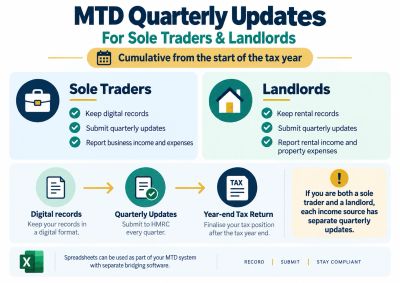
Quarterly updates are cumulative, and if you have both self-employment and property income, those income sources are reported separately.
What Is an MTD Quarterly Update?
A quarterly update is a summary of the income and expense information held within your digital records.
Your MTD-compatible software uses those records to produce the figures that are sent to HMRC.
Quarterly updates are not tax returns, and you do not normally make all of your year-end tax and accounting adjustments before sending them.
Quarterly Updates Are Cumulative
This is an area that can easily cause confusion.
Under the current MTD rules, each quarterly update covers the period from the beginning of the tax year up to the end of that quarterly update period.
For someone using the standard MTD periods:
Update Figures included in Quarter 1 is from 6th April to 5th July, Quarter 2 is from 6th April to 5th October, Quarter 3 is from 6th April to 5th January, Quarter 4 us from 6th April to 5th April
So Quarter 2 does not contain only the figures for July to October. It contains the cumulative figures from 6 April to 5 October.
Likewise, Quarter 4 contains the figures for the whole tax year.
HMRC introduced this cumulative approach so that corrections made to your digital records can flow into the next update without you generally having to go back and resubmit previous quarterly updates
MTD for Sole Traders
If you are within Making Tax Digital for Income Tax, you must keep digital records for your self-employed business.
These records include your business income and expenses.
Your quarterly update is then produced from those digital records and sent to HMRC through compatible software.
Depending on the circumstances of the business, the update may include categories such as:
- Turnover
- Other business income
- Cost of goods
- Wages and staff costs
- Travel
- Premises costs
- Repairs
- Office costs
- Advertising
- Financial costs
- Professional fees
- Other business expenses
HMRC's quarterly update requirements set out the income and expense information that may need to be reported for self-employment.
MTD for Landlords
Landlords within MTD must also maintain digital records of their property income and expenses.
This can include:
- Gross rents
- Other property income
- Repairs and maintenance
- Insurance and ground rent
- Management and professional fees
- Services and wages
- Travel expenses
- Other allowable property expenses
- Residential property finance costs
Residential property finance costs are particularly important because they are identified separately within the MTD property categories.
Your property figures are used to create cumulative property quarterly updates in the same way as your self-employed figures.
What If You Are Both a Sole Trader and a Landlord?
This is one of the most important parts of MTD to understand.
Your qualifying income for deciding whether MTD applies can include both self-employment and property income.
However, once you are within MTD, the income sources are not simply combined into one quarterly update.
If you have a self-employed business and a UK property business, your software maintains and reports the relevant figures for each business separately.
For example:
Sole Trader Business
→ Digital business records
→ Sole Trader Quarterly Update
Property Business
→ Digital property records
→ Property Quarterly Update
HMRC states that quarterly updates are required for each self-employment and property business that you have.
This is why keeping your records properly separated from the beginning is so important.
Do Quarterly Updates Mean Paying Tax Every Quarter?
No.
Sending a quarterly update does not mean that your Income Tax suddenly becomes payable every three months.
Quarterly updates are a reporting requirement.
They provide HMRC with information from your digital bookkeeping records throughout the tax year.
After the end of the tax year, you will review your information, make any necessary adjustments, include your other income and gains where required, check the tax calculation and submit your tax return through your MTD software.